Hiển thị các bài đăng có nhãn Bee. Hiển thị tất cả bài đăng

Thứ Bảy, 18 tháng 2, 2012

Hornet

 
The Life of Animals | Hornet | If a hornet is killed near a nest the which it may release pheromones can cause the other Hornets to attack.  Generally Yellowjackets are smaller than the Hornets and are bright yellow and black, whereas Often the Hornets may be black and white wasp and bee-see characteristics. Another major difference is the Hornets and Yellowjackets Between each of Their food choices and aggression towards Humans. In autumn, Yellowjackets may be attracted to human foods and food wastes, Increasing Between Potentially aggressive contact Yellowjackets and Humans


Stings Hornets have used to kill prey and defend nests. Hornet Stings are more painful to Humans than typical hornet wasp venom contains Stings Because a large amount (5%) of acetylcholine.See Schmidt Sting Pain Index. Individual Hornets can sting multiple times; unlike typical bees, Hornets and Wasps do not die after stinging Because Their Stingers are not barbed and are not pulled out of Their bodies. The toxicity of hornet Stings According to hornet species varies; some deliver just a typical insect sting, while others are known Among the most Venomous insects hornet Single Stings in Themselves are not fatal, except Sometimes to allergic Victims.  The Stings of the Asian giant hornet (Vespa mandarinia japonica) are the most Venomous known. People who are allergic to wasp venom are also allergic to hornet Stings.


Some other large Wasps are Sometimes Referred to as the Hornets, most bald-faced Notably the hornet (Dolichovespula maculataand) found in North America. The name "hornet" is used for this and related species, primarily Because of Their habit of making aerial nests (similar to the true Hornets) rather than subterranean nests.

Carpenter bee

  
The Life of Animals | Carpenter bee | In Several species, Females live alongside the daughters or sisters Their Own, creating a sort of social group. They use wood bits to form partitions Between the cells in the nest. A few species bore holes in wood Dwellings.  In the United States, there are two eastern species, Xylocopa virginica, and Xylocopa micans, and three other species are primarily western in That distribution, varipuncta Xylocopa, Xylocopa Xylocopa californica and tabaniformis orpifex.


Males of some species have a white or yellow face, where the Females do not; males also have much larger eyes Often than the Females, the which relates to Their mating behavior. Male bees are Often seen hovering near nests, and will approach nearby animals.  Female carpenter bees are capable of stinging, but They are docile and rarely sting unless caught in the hand or otherwise directly Provoked. The exact nature of the relationship is not fully Understood, though in other bees That carry mites, the mites are beneficial, feeding either on fungi in the nest, or on other, harmful mites Carpenter bees are solitary bees Traditionally Considered, though some species have simple social nests in the which mothers and daughters may cohabit.


Carpenter bees the make nests by tunneling into wood, vibrating Their bodies as They rasp Their mandibles against the wood, each nest having a single entrance the which may have many adjacent tunnels. Carpenter bees do not eat wood. The provision Masses of some species are Among the most complex in shape of any group of bees; whereas most bees fill Their Brood cells with a soupy mass, and others form simple spheroidal pollen Masses, Xylocopa form elongate and carefully sculpted Masses That Several projections have the which keep the bulk of the mass from coming into contact with the cell walls, resembling an irregular caltrop Sometimes.


Species in the which the males have large eyes are characterized by a mating system where the males either search for Females by patrolling, or by hovering and waiting for passing Females, whom Pursue They then. The pheromone advertises the presence of the male to Females.

Wasp


The Life of Animals | Wasp | Male Yellowjacket Wasps, for example, have 13 divisions per antenna, while Females have 12.  The Difference Between Wasps sterile female workers and queens also varies Generally Between species, but the queen is noticeably larger than both males and other Females. Unlike bees, Wasps Generally lack plumose hairs. The type of nest produced by Wasps can depend on the species and location. Many social Wasps That Produce nests are constructed predominantly from paper pulp.


The Various species of Wasps fall into one of two main categories: social and solitary Wasps Wasps. Adult solitary Wasps live and operate alone, and most do not construct nests (below); all adult solitary Wasps are fertile. By contrast, social Wasps exist in Colonies numbering up to Several thousand individuals and build nests in some cases but not all of the colony can reproduce. In some species, just the wasp queen and male Wasps can mate, whilst the majority of the colony is made up of sterile female workers. Like all insects, Wasps have a hard exoskeleton covering Their three main body parts.


Social Wasps also use other types of nesting material mixed in with That Become the nest and it is common to find nests located near to the plastic pool or trampoline covers Incorporating distinct bands of color That Reflect the inclusion of these materials have simply been That chewed up and mixed with wood fibers to give a unique look to the nest. Again each species of social wasp Appears to Favour its own specific range of nesting sites. By contrast solitary Wasps are parasitic or predatory and Generally only the latter build nests at all. Unlike honey bees, Wasps have no wax producing glands. Wood fibers are gathered locally from Weathered wood, softened by chewing and mixing with saliva.


Not all social castes That Wasps have are physically different in size and structure.  All female Wasps are Potentially capable of Becoming a colony's queen and this process is determined by the which Often female successfully lays eggs first and begins construction of the nest. Evidence Suggests That Females Compete amongst each other by eating the eggs of other rival Females.  Polistine nests are considerably smaller than many other social wasp nests, housing only around 250 Typically Wasps, compared to the Several thousand common with Yellowjackets, and have the smallest stenogastrines Colonies of all, rarely with more than a dozen Wasps in a mature colony.


Bumble bee


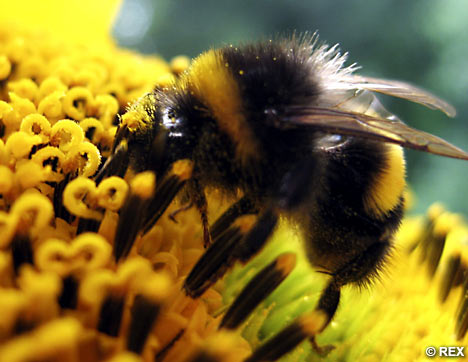
The Life of Animals | Bumble bees | Bumble bees are found in higher latitudes Typically and / or high altitudes, though exceptions exist (there are a few Lowland tropical species) A few species (Bombus polaris and B. alpinus) range into very cold climates where other bees Might not be found B . Bumble bees Their body temperature can regulate, via solar radiation, internal Mechanisms of "shivering" and radiative cooling from the abdomen (called heterothermy). Other bees have similar physiology, but the Mechanisms have been best studied in Bumble bees.


The eggs hatch develop into female That workers, and in time the queen populates the colony, with workers feeding the young and performing other duties similar to honey bee workers.  According to the Oxford English Dictionary (OED), the term Bumble bee was first recorded as having been used in the English language in the 1530 work by John Palsgrave Lesclarcissement, "I bomme, as a bombyll bee dothe."  The latter term was used in A Midsummer Night's Dream (circa 1600) by William Shakespeare, "The honie-bags steale from the humble Bees."


"Said the Bumble Bee." In the post-World War II era, however, be humble-bee fell into near-total disuse. The orchestral interlude "Flight of the Bumblebee" was composed (circa 1900) by Nikolai Rimsky-Korsakov to Represent the turning of Prince Guidon to visit his father, Tsar Saltan, in the opera The Tale of Tsar Saltan, although the music is Considered to Reflect more accurately the flight of a Bluebottle than a bumblebee.The music inspired Walt Disney to feature a Bumble bee in his 1940 animated musical Fantasia and have it sound as if it were flying in all parts of the theater.  The archaic English colloquialism dumbledor (also used for cockchafers) is the source of the name Albus Dumbledore, a fictional character from the Harry Potter series (1997-2007).